NDT James V-Meter MK IV Ultrasonic Structural Determining System
CODE: ULTRA VMETER
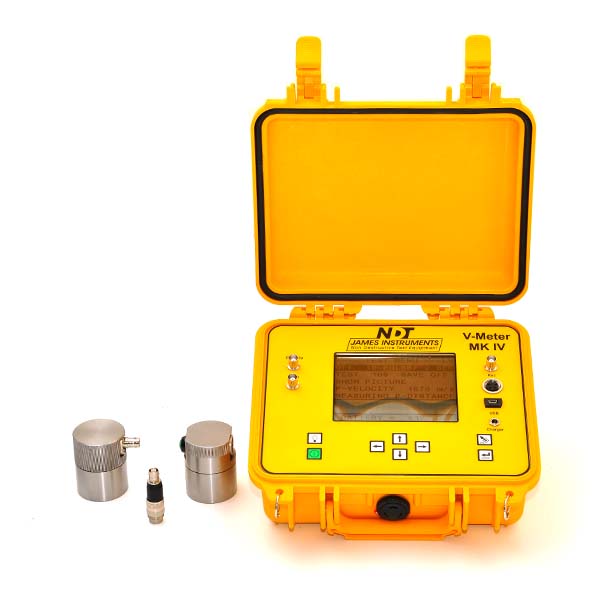
The V-Meter MK IV from James Instruments is an Ultrasonic Pulse Velocity System used for finding voids and cracks in structures as well as determining the material properties.
It is suitable for use on concrete, wood and ceramic materials.
Concrete
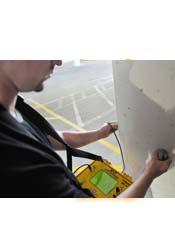
The V-Meter MK IV is widely used and accepted for quality control and inspection of concrete.
It can measure and correlate concrete strength to standard strength measurement, permitting non-destructive testing of complete structures.
It will identify honeycombs, voids, frozen concrete, cracks and other non-homogenous conditions in concrete.
Ultrasonic testing can be applied to new and old structures, slabs, columns, walls, fire damaged areas, hydroelectric structures, pipe, prefab and pre-stressed beams, cylinders and other concrete forms.
A wide range of transducers are available.
Wood
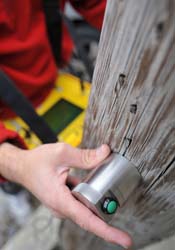
Using the V-Meter MK IV, ultrasonic testing of wood can, non-destructively, detect knots, shakes, splits, grain orientation, windfall cracks and presence of decay and rot.
Basic parameters such as modulus of elasticity and density can be calculated.
Practical applications include field testing of utility poles and structures, grading in the manufacturing process, fire ladder inspection, examination of laminates and paper roll density.
The velocity of ultrasonic energy pulses traveling in a solid material are related to the density and elastic properties of the material. The pulse velocity is thus a measure of density and elastic properties of the material. In transmitting ultrasonic energy through a coarse grained material such as concrete, ceramics or wood, it is necessary for the wave length of energy to be greater than the diameter of the largest grain particle.
If it is not, all of the energy will be reflected back by the particles and none will reach the receiver. Typically, the 54 kHZ transducers are used for wood testing. The signal wave length is about 3 inches (75mm).
Finer materials require higher frequencies for optimum resolution.
Ceramics
The V-Meter MK IV has been successfully applied to a range of ceramic products including tile, refractory bricks and blocks, and kiln furniture as well as graphite.
In an increasing number of refractory and ceramic applications, the ultrasonic pulse velocity testing technique has been used with positive results. UPV testing has enabled users to improve their production processes, increase the integrity and quality of their products, and reduce scrap and reject rates-thereby saving both time and money.
In today's economy, such bottom-line benefits are difficult to ignore.
The instrument has an easy to view display (320 by 240 pixels). The backlight for daylight use, makes field work easier and faster, since the operator can identify good results in seconds without the problems related with the sun light reflection on the screen. The signals can be recorded in the instrument for review on the screen or for transfer to a PC.
More detailed information is available on exactly how the V Meter works, the measuring principle and ultrasonic sensors.
Product specifications
.
- Measurement Method: NDT Ultrasound
- Receiver Sensitivity: 250 micro volts, between 30 kHz and 100 kHz
- Receiver Input Impedance: approximately 100k Ohms
- Transit Time Measurement: 0.1 to 6553.5 microseconds, direct digital display
- Measurement Accuracy: 0.1 microseconds
- Transmitter output: pulse 1000/500V, 2 microseconds
- Transmitter pulse group rate: selectable 1, 3 or 10
- Gain Selection: 1, 5, 10, 25, 50, 100, 250, 500
- Display: LCD 320 by 240, backlit for daylight use
- Memory Storage: greater than 1800 values
- Weight: 2.75 kgs
- Battery Type: Lithium Ion 14V
- Battery Life: 4-10 hours continuous use
The V-Meter MKIV is available in various packages. Please contact us to ascertain which package is best suited.
|