Accurate Instruments Accurate Instruments NZ Ltd
FREEPHONE : 0800 500 380
AUCKLAND WELLINGTON CHRISTCHURCH
HOME SALES & PURCHASING SERVICING HIRE CONTACT US FULL PAGE INDEX


Cat & Genny4 Cable Locator


Cat & Genny Cable Avoidance Tool

click on image to enlarge


download PDF brochure

download PDF locating guide

download PDF user manual


For simple underground location of power cables prior to digging, drilling or any civil/construction work, the Cat & Genny is still one of the most popular and well know products available on the market - worldwide.
In an ever more regulated industry, the latest generation CAT4TM & GENNY4TM "Cable Avoidance Tool" is now available, specifically designed to help the operator locate more buried utilities.

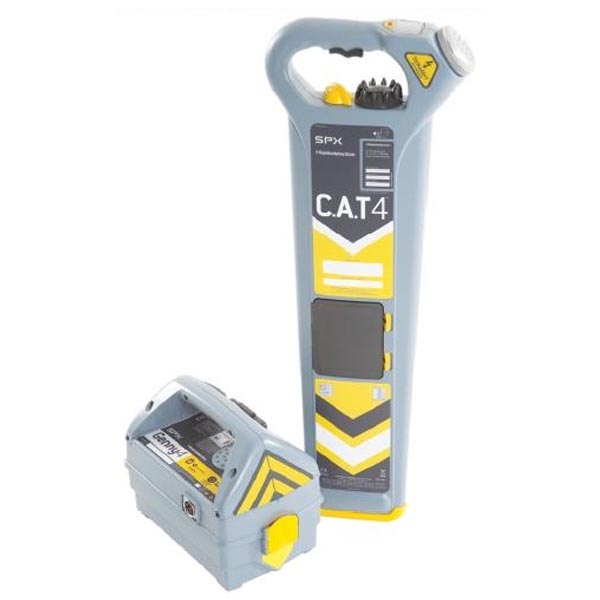
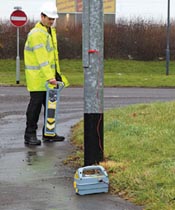
The standard package consists of two components, the CAT4TM detector and the Genny4TM transmitter box.

CAT4
The CAT4 detector can detect signals that naturally radiate from metallic services. This is typically underground power that is live.
It is used as an estimating search tool to try and generally locate cables.
Consulting plans or engineering reports will aid the user in knowing where to start searching.
One key feature of the CAT4 is the StrikeAlertTM feature. It is designed to assist the operator in reducing the number of shallow cable strikes.

Genny4
Featuring a simultaneous dual-frequency signal output, the Genny4 transmitter is used to "induce" or apply a distinctive signal into either the metallic materials or utility services, enabling the user to easily identify the location of the underground cable.
Alongside the familiar 33kHz locating signal for general location purposes, the Genny4 transmits a second frequency designed to facilitate the location of small diameter cables such as telecommunications and street lighting, including spurs.

Also, using the transmitter, the approximate depth can also be viewed.
The Genny4 also has a Signal Boost feature which increases the output signal by up to 10 times allowing you to locate cables with the CAT4 over extra distance and depth.

The Radiodetection C.A.T. 4TM and GENNY4TM has become the industry standard pipe and cable avoidance tool, recognised as the leader across all industry segments providing performance, ruggedness and reliability, together with affordability and low cost of ownership.


Different modes of Operation

There are 4 different modes of operation, all controlled on dial of the CAT4 detector.

A Avoidance mode
- Simultaneously searches for and pinpoints Genny Power and Radio signals.

G Genny signal locate
- Detects the signals transmitted by Genny4, with on-demand estimation of the depth of buried utilities.

P Power signal locate
- Detects the electromagnetic fields generated by loaded power cables.

R Radio signal locate
- Detects long-range radio signals as they travel along buried cables and pipes.


An optional Flexitrace (which is a 50metre 6mm diameter rod with wire conductors) can be used to help trace non-metallic pipes (i.e. plastic pipes).
More information on the Flexitrace can be found below.

The Radiodetection C.A.T. 4TM and GENNY4TM has become the industry standard pipe and cable avoidance tool, recognised as the leader across all industry segments providing performance, ruggedness and reliability, together with affordability and low cost of ownership.


Tracing non metallic pipes


To trace non-metallic pipes, a trace wire or sonde needs to be run inside the pipe.
A sonde is usually on the end of a push rod but needs two people to operate. One person pushs the sonde through the pipe while the other person tracks the end with the locator, as it moves through the pipe.

The FLEXITRACE is a better option for standard pipes, as once it is pushed through the pipe, it provides a continuous trace line the length of the pipe and therefore one person operation.
The operator can go backwards and forwards checking the position of the buried pipe.


FLEXITRACE
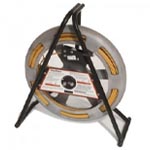
The Flexitrace is a 50metre 6mm diameter rod and has wire conductors running its full length and a transmitting coil at the end.
The Genny4 is then connected to the rod and coil enabling its location to be traced the entire length to a maximum depth of 3m.
Connecting the Genny4 to both terminals on the Flexitrace means it can be used like a Sonde. Alternatively connecting the Genny4 to one terminal and ground allows tracing of its entire length like a cable.

The Flexitrace fits into pipes as small as 12mm with a minimum bend radius of 250mm.

FLEXIROD


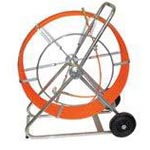
The Flexirod is used for pushing sondes into and along pipes up to 120m (60m model available).
It is a 9mm glass fibre rod in a polypropylene sleeve that is resisitant to abrasion, most solvents, oils and acids.
The rod has a minimum bend radius of 250mm and at each end a brass collar 62mm in length with a female M10 x 20mm thread suitable for attaching all Radiodetection sondes.
The rod is wound onto a steel spool.
The spool has a manual brake to help the user maintain control of the rod.

33kHz SONDES
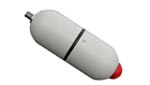
Standard Sonde - combines compact size with a strong signal. This is the standard type of sonde for most applications.

Sewer Sonde - has a very strong enclosure suitable for the most abrasive and rugged duty in municipal sewer systems.

Super Sonde - strong construction designed for use in deep sewers.


CAT4 & Genny4 specifications

- Frequency detection (Power): 50 Hz - 3.5 kHz
- Frequency detection (Radio): 15 - 30 kHz
- Frequency (Genny4): 33 kHz +/-20Hz
- Location Accuracy: typically +/- 10% of depth
- Depth Range (Line): 0.1 to 3 metres
- Depth Range (Standard Sonde): 0.1 to 7 metres
- Power Output (Genny4): 0.1 Watt
- Typical Battery Life: up to 40 hrs (CAT4), 30 hrs (Genny4)
- Weight: 2.3kg (CAT4), 2.7kg (Genny4)
- Operating Temperature: -20 to +50° C
- Weather Protection: IP54


Standard package includes:

CAT4 Receiver, Genny4 Transmitter box, alkaline batteries, standard locator clamp, carrying bag and operating manual.

enquire for price


Accurate Instruments (NZ) Ltd. is a 100% New Zealand owned company.
Site Design copyright (c) 2016 LISBURN DESIGNS